EEG, AI & everyday questions
Can an EEG headset read your mind?
A pizza thought, a moving cursor, and a closer look at what the research actually tested.
Imagine wearing a headset while looking at your laptop. You think about pizza. A cursor moves. Your friend gasps: “It knows your order!” In this made-up scene, you have a more urgent question: did it read your mind, or did everyone just jump to a very tasty conclusion?
The short answer: not in the movie sense shown above. The EEG-and-AI study below tested ways to guide a cursor and a robot through set tasks. It did not test whether a headset could read any thought that popped into someone’s head. Useful control and free-form mind reading are different claims.[3]
Start with a signal, not a sentence
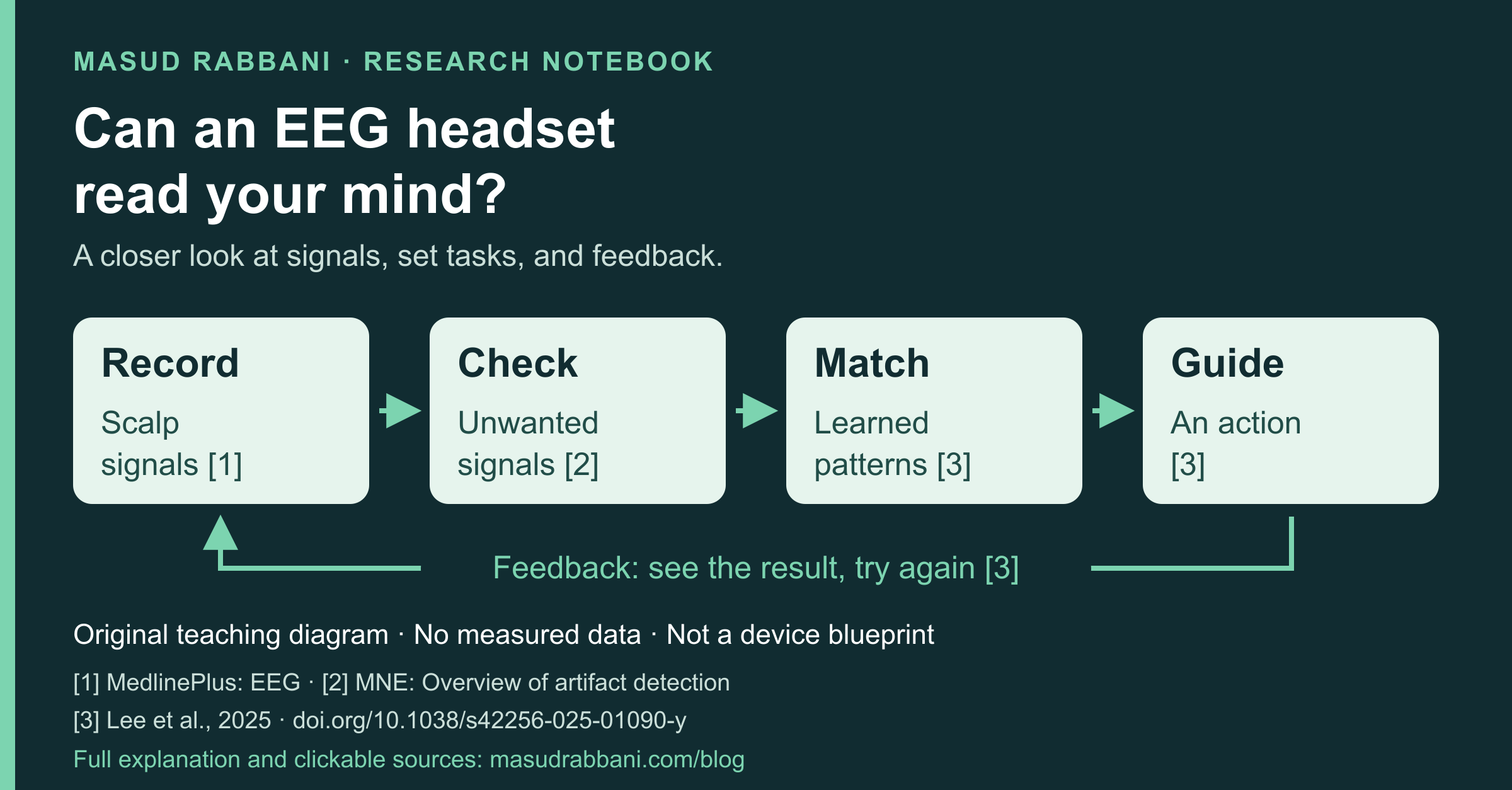
EEG [a recording of the brain’s electrical activity] uses electrodes [small sensors] on the scalp. A recording machine turns the signals into wave-like traces. Those lines are measurements of electrical activity, not words printed by the brain.[1]
Think of listening outside a busy room. You may hear a pattern, but that is not the same as hearing every sentence. This is only an analogy. It is a way to keep a signal separate from the meaning we give it.
The recording can also pick up blinks, eye movements, and muscle activity. Researchers call unwanted parts artifacts [signals that get in the way of what they want to study]. They check for them and may leave out affected data or reduce the unwanted signal. Cleaning is a step to check, not magic.[2]
What the evidence shows
A study published in September 2025 paired a non-invasive EEG system [one that does not need a brain implant] with AI copilots [software helpers that share control]. People used it for cursor targets and moving blocks with a robotic arm. The study included a participant with paralysis. The helpers used information about the task, alongside the EEG-based control.[3]
The important limit is the task. These were tests with specific goals. Their results do not establish a system that reads a person’s full stream of thoughts. They show a way to help with defined actions.[3]
Our research: what happens after the prediction?
Research spotlight · Coauthored work
Agentic AI for EEG-Based Brain–Computer Interfaces: A Review of Methods, Systems, and Applications
In our 2026 review, my coauthors and I examine methods, systems, and uses of EEG-based brain–computer interfaces [systems that turn brain signals into computer or device commands]. We connect work on detecting brain-signal patterns with a further question: how could a system respond and use feedback? Topics include attention, driving-related tasks, and listening.[4]
This is where agentic AI [AI that can choose and carry out steps toward a goal] enters our review. We discuss moving from giving a signal a label to systems that sense, act, and adapt. The paper maps methods and open problems; it does not present a new headset or a clinical trial proving that such a device works.[4]
The review also flags signals changing across people and sessions, small datasets, and gaps between lab tests and daily use. My take: it offers a starting map for asking better design questions. If your work discusses EEG methods or feedback-based systems, read the original paper and assess whether it supports your point.[4]
View citation & all coauthors
Masud Rabbani, Rubaba Amyeen, Md Mazhar Hossain, Mostofa Rafid, Iysa Iqbal, Hansika Kolli, Sheikh Iqbal Ahamed. “Agentic AI for EEG-Based Brain–Computer Interfaces: A Review of Methods, Systems, and Applications”. 2026 IEEE 50th Annual Computers, Software, and Applications Conference (COMPSAC), 2844–2852. (2026). https://doi.org/10.1109/COMPSAC69091.2026.00428.
If this work supports your research, cite the original paper rather than this blog explanation.
Could you spot the overclaim?
A quick thought experiment
Imagine an advert says: “Our headset passed a cursor task, so it can read any thought.” What would you ask first?
Three questions to keep handy
When I read the next headline, these are the questions I would ask: What exact task did people do? Who was included in the test? What happens when the system gets it wrong? I would also want a clear way for the user to stop an unwanted action. These are my design priorities, not a claim that every current system provides them.
A question for a future post: when an AI helper and its user disagree, who should have the final say? I would start with the person.
Sources & further reading
- EEGMedlinePlus Medical Encyclopedia / A.D.A.M.; reviewed by Luc Jasmin and the editorial team · Reviewed January 13, 2025
- Overview of artifact detectionThe MNE-Python contributors · Documentation 1.13.2; checked 2026-09-11
- Brain–computer interface control with artificial intelligence copilotsJohannes Y. Lee, Sangjoon Lee, Abhishek Mishra, Xu Yan, Brandon McMahan, Brent Gaisford, Charles Kobashigawa, Mike Qu, Chang Xie, Jonathan C. Kao · September 1, 2025
- Agentic AI for EEG-Based Brain–Computer Interfaces: A Review of Methods, Systems, and ApplicationsMasud Rabbani, Rubaba Amyeen, Md Mazhar Hossain, Mostofa Rafid, Iysa Iqbal, Hansika Kolli, Sheikh Iqbal Ahamed · 2026
Disclaimer: This post is for education, not medical or other professional advice; information may contain errors or become outdated, no outcome is guaranteed, views are my own, and third-party materials remain subject to their owners' rights.